
Using AI to advance human-centered healthcare
Build the pathway your department will actually follow.
Any department, in any specialty or setting, builds, votes on and signs its own care pathways here. Start from a quality measure, a safety event, a care gap or a clinical question. AI searches and grades the evidence and drafts the pathway; your clinicians vote on each step, test it and sign it.
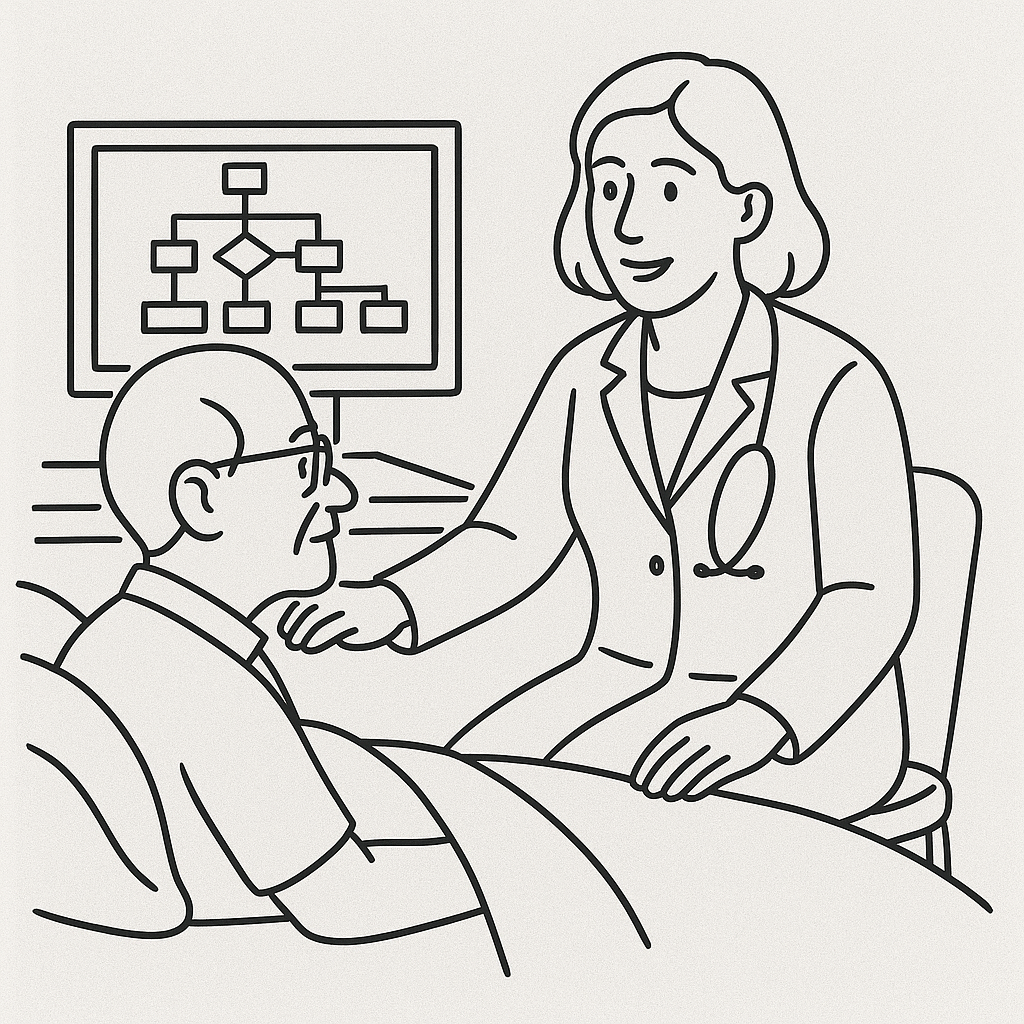
We have all been the patient, or sat beside one. I want what every patient deserves: care that is evidence-based, human-centered, and agreed on before I arrive.
What your department gets
Decided once, together, for the whole department.
Every pathway comes out with the same eight things, every time, all free.
-
Approval Record
Who approved what, when, on what evidence, and in which version.
-
Consensus Record
Each recommendation voted on by your panel, round by round, dissent included.
-
Automatic tracking
Rounds, the usability survey and reminders sent for you; every response tracked.
One format for every pathway. Each step opens its evidence, on any phone, from a link your chart or intranet can hold.
-
Education Modules
One per role, with completion tracked in your group.
-
Patient Version
Each step in plain language, beside the care-team page.
-
Pathway Paper
Your quality improvement manuscript, drafted and ready to submit.
-
Admin Dashboard
Each member’s role, pathways and completed modules, in one view.
Medical and quality directors can also request early access to the pathway agent, which answers questions from the Library, or from your institution's pathways only, with every answer tracing to a signed step.
How it works
AI drafts. The software checks. Your clinicians decide.
-
Scope
Name the problem, the setting and population, and the goals it will be measured against. Attach your hospital's own protocols.
-
Draft
An editable PubMed search, graded by you. Pathway Author drafts the decision tree with your cutoffs and resources; Evidence Check checks every branch.
-
Review
Your panel votes on each recommendation, round by round; your approvers sign last. My Dashboard shows how far each pathway has come.
-
Publish
Publish to the Library under your name. Share the interactive care-team page by link, not a static PDF; the Patient Version, the Education Modules and the Pathway Paper publish with it.
No technical background needed, and nothing to install: the page you publish is in use the day you share the link.
Why you can put your name on it
Almost no decision in a pathway belongs to one specialty or one role.
Get the agreement before anyone is asked to follow it.
Evidence-based
Every citation is checked against its source. Every grade comes from a fixed rule.
Consensus-recorded
Colleagues vote on each recommendation; disagreement is recorded, not hidden.
Case-stressed
The Case Simulator runs synthetic cases through it before a real patient meets it.
Frontline-tested
Clinicians who did not write it walk cases through it first.
No patient data, no BAA, no EHR connection. A community hospital or physician group starts the same day an academic center does.
Why it matters
AI search tools give individual clinicians an answer.
CarePathIQ gives a department ownership of its clinical decisions, made once, so every clinician can focus on the patient.
Building takes hours; review is one survey, not months of meetings. The score, criteria, and consult timing are settled in the pathway, not worked out at the bedside, and every patient gets the same decision, whoever is on that day.
More than a third of U.S. physicians and nurses report substantial burnout, and the National Academy of Medicine traces it to how the work is designed, not to the people doing it. As one physician who left practice put it, “You cannot patch up systems issues with individual sacrifice.” A care pathway is a structural fix any clinician can build. After a safety event, the fix lands in the pathway and the systems around it, not on one clinician.
Accreditors often ask a hospital to show that each protocol was approved by a multidisciplinary group, rests on recognized evidence, and is reviewed again. The Approval Record is that evidence, built as you author, and a written standard can be audited for who it serves.
What you can do here
For every clinician on the team.
Physicians, nurses, advanced practice providers (APPs), pharmacists, social workers, case managers and residents, in emergency medicine, hospital medicine, pediatrics, primary care, surgery, obstetrics, oncology, behavioral health and post-acute care.
AI Studio
Name a clinical problem. Leave with a pathway your clinicians voted on, shared as an interactive page.
Build for free
Library
Grows one signed pathway at a time, each under its authors' names, with its evidence, grades, and votes. Reuse any of them with an account.
Browse the Library
Course
Care Pathway Fundamentals: five short video modules. No account needed.
Browse the modules
Weekly Roundup
New papers on AI in clinical care, and what they mean for your systems. On Substack.
Read the latest
About
Built by a clinician, for clinicians.
CarePathIQ was built by Tehreem Rehman, MD, MPH, MBA, a practicing emergency physician and board-certified clinical informaticist, so that any clinician can build and revise a care pathway without writing code, in a community department as much as a large academic center. Most clinical AI arrives pre-built, priced for health systems, and shaped without the clinicians who use it; this was built the other way around. She is nationally recognized for her work on patient-facing AI, AI-augmented operations, and digital health equity. More about CarePathIQ.
CarePathIQ is where a department decides, records, and signs the care pathways every AI in its hospital runs on.
Leading a health system? Talk to us about a design partnership.