Weekly Evidence Roundup · May 4, 2026
AI scribes can save clinicians time. The harder question is what your hospital does with them.
What They Found The first peer-reviewed multisite trial of ambient AI scribes is out, and the time savings are smaller than the marketing implied. Rotenstein et al. , publishing in JAMA , tracked 8,581 clinicians across five academic health systems (Mass General Brigham, UCSF, Emory, Yale New Hav
What They Found
The first peer-reviewed multisite trial of ambient AI scribes is out, and the time savings are smaller than the marketing implied. Rotenstein et al., publishing in JAMA, tracked 8,581 clinicians across five academic health systems (Mass General Brigham, UCSF, Emory, Yale New Haven, and UC Davis) over two years. Of those, 1,809 adopted an ambient AI scribe and 6,772 served as concurrent controls. The team measured EHR time, documentation time, and visit volume across the full deployment window, drawing on telemetry the EHR vendors collect natively rather than self-report. The study is the first published output of the multi-institutional Ambient Clinical Documentation Collaborative (ACDC).
What the data showed: AI scribe adopters spent 13 minutes less per day in the EHR (a 3% relative reduction) and 16 fewer minutes per day on documentation (a 10% relative reduction) compared with non-adopters. They also saw roughly 0.5 additional patient visits per week. Real, but modest — and concentrated. Only 32% of adopters used the scribe on more than half of their visits, and those heavy users captured the bulk of the benefit. For the other 68%, the savings were considerably smaller. The headline averages, in other words, are an average of one cohort that uses the tool and one that mostly does not.
Why the headlines miss the harder question
-
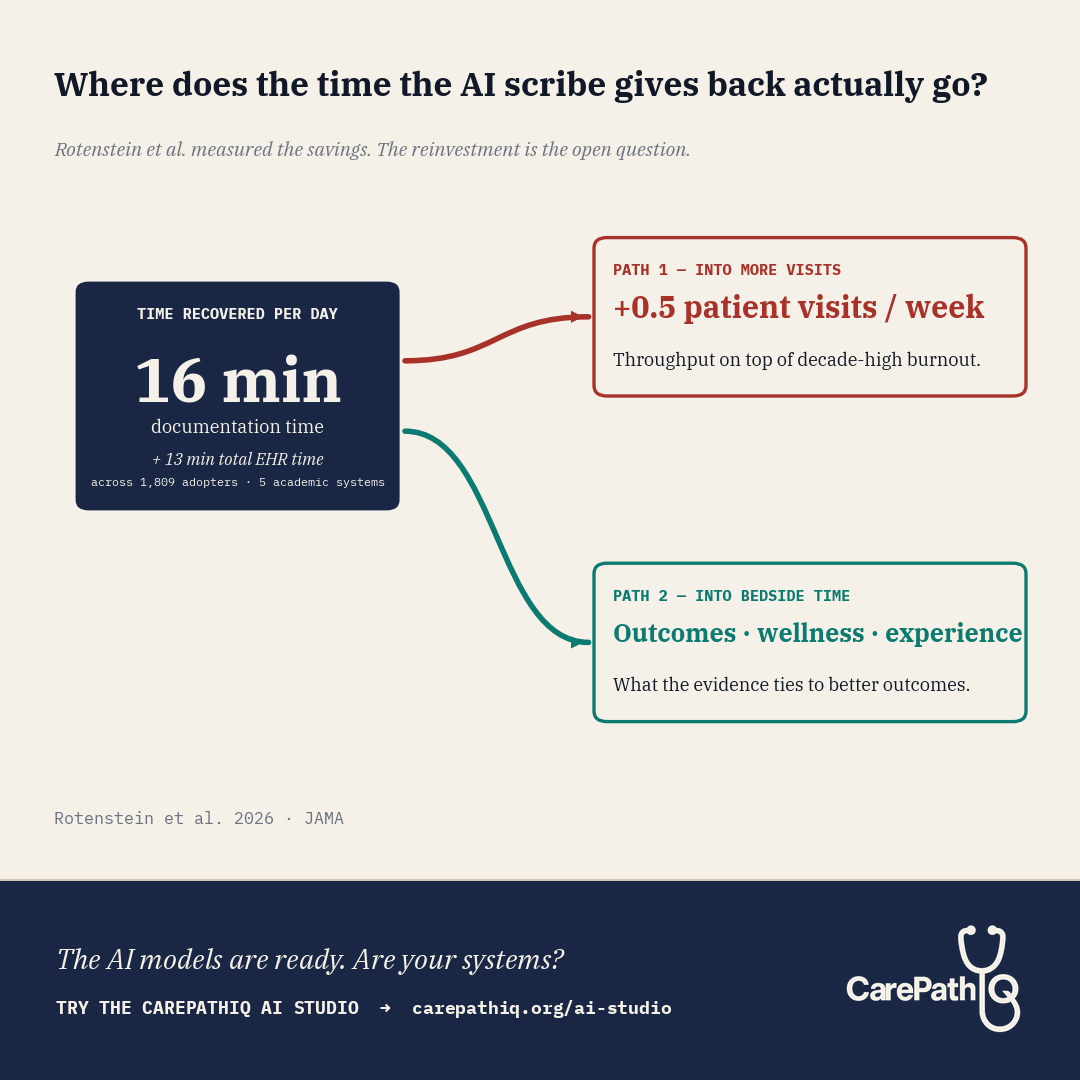
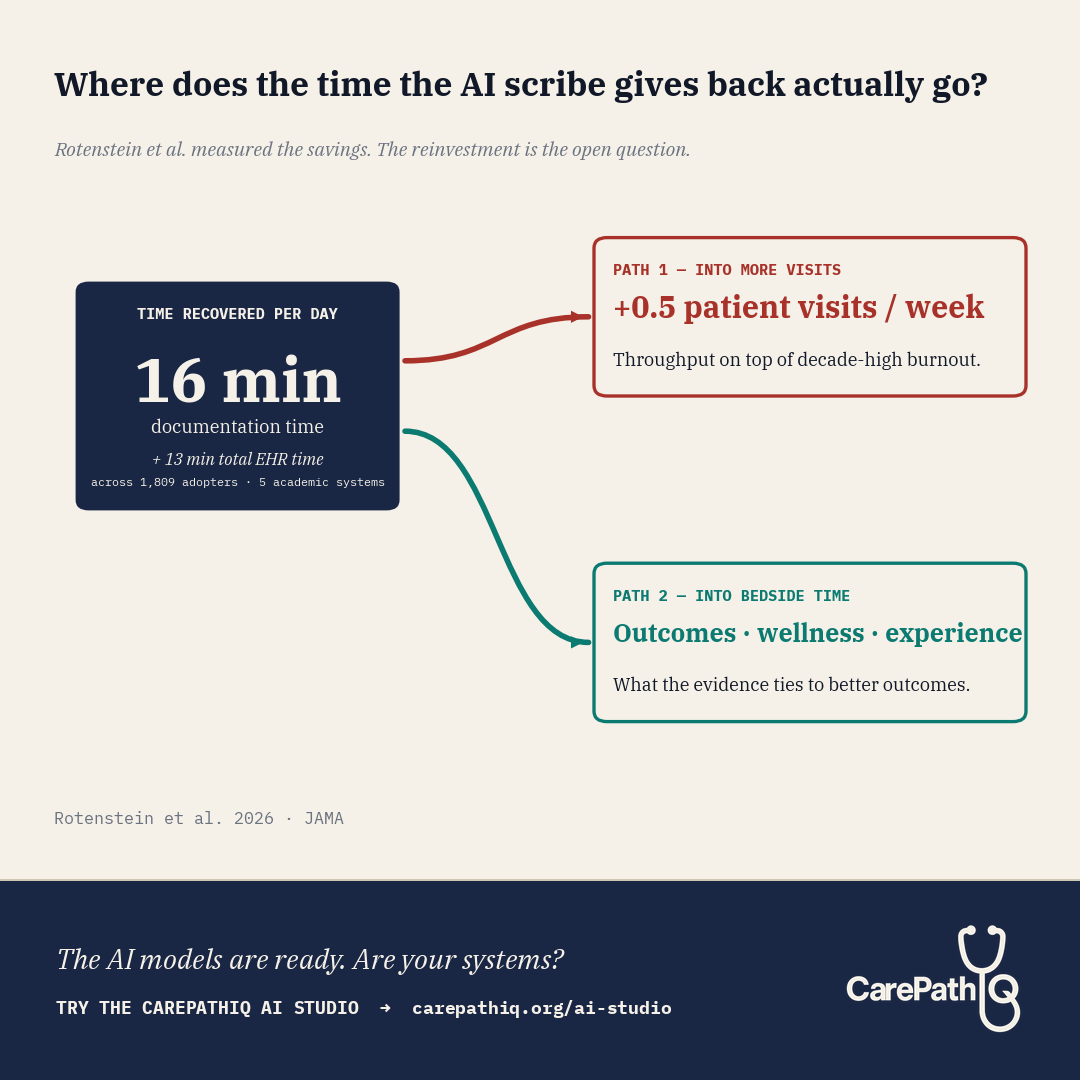
Time saved is a budget, not a benefit. Rotenstein reports 0.5 additional patient visits per week as a productivity outcome, which a procurement conversation is likely to read as “great, more throughput.” Many health systems entered 2026 already planning to fold AI-driven time savings into clinician volume targets, on top of a workforce where burnout is already at decade highs.
-
The evidence on bedside time points the other way. Time spent with patients, not the number of patients seen per shift, is what the literature ties to better health outcomes, lower clinician burnout, and stronger patient experience. Reinvesting AI-scribe savings into more visits would aim those minutes in the opposite direction of where the evidence actually leads.
-
The savings are real, but uneven. Even before the reinvestment question, the 16 minutes is a cohort average. Only 32% of adopters used the scribe on more than half of their visits, and those heavy users captured the bulk of the benefit. The “give clinicians their time back” framing describes what one third of adopters experienced consistently. For the other two thirds, the gain is closer to noise than to a workday-changing intervention.
Why it matters now
Ambient-scribe contracts at major systems run into the millions per year, and the 2026 renewal cycle is underway. The Rotenstein study results suggest the ROI hinges on two questions: whether a system can drive consistent use, and what it does with the time the AI scribe gives back. The time savings are real. Where the time gets reinvested is the procurement decision that has barely entered the conversation.
The procurement question is not “which AI scribe?” It is “where does the time the AI scribe gives back actually go?”
What CarePathIQ Is Building in Response
CarePathIQ does not make ambient scribes. But the adoption-depth pattern this paper surfaces shows up across most of the clinical AI a frontline team encounters, the ED included. The AI Studio is being built so pathway architecture for the whole care team (clinicians, pharmacists, nurses, social workers) can be transparent and live inside existing workflows. Returning time to the bedside starts there.
Try the CarePathIQ AI Studio → carepathiq.org/ai-studio